By
Jin Kim
February 17, 2026
•
5
min read
.png)
I left SCOPE Summit 2026 feeling something I don’t always associate with large industry conferences: hope.
Across fireside chats, panels, exhibit hall, and side conversations, one theme kept resurfacing. Clinical trials are not just operational systems to optimize or timelines to squeeze. First and foremost, they are acts of trust between patients, sites, sponsors, and ultimately, the broader healthcare system.
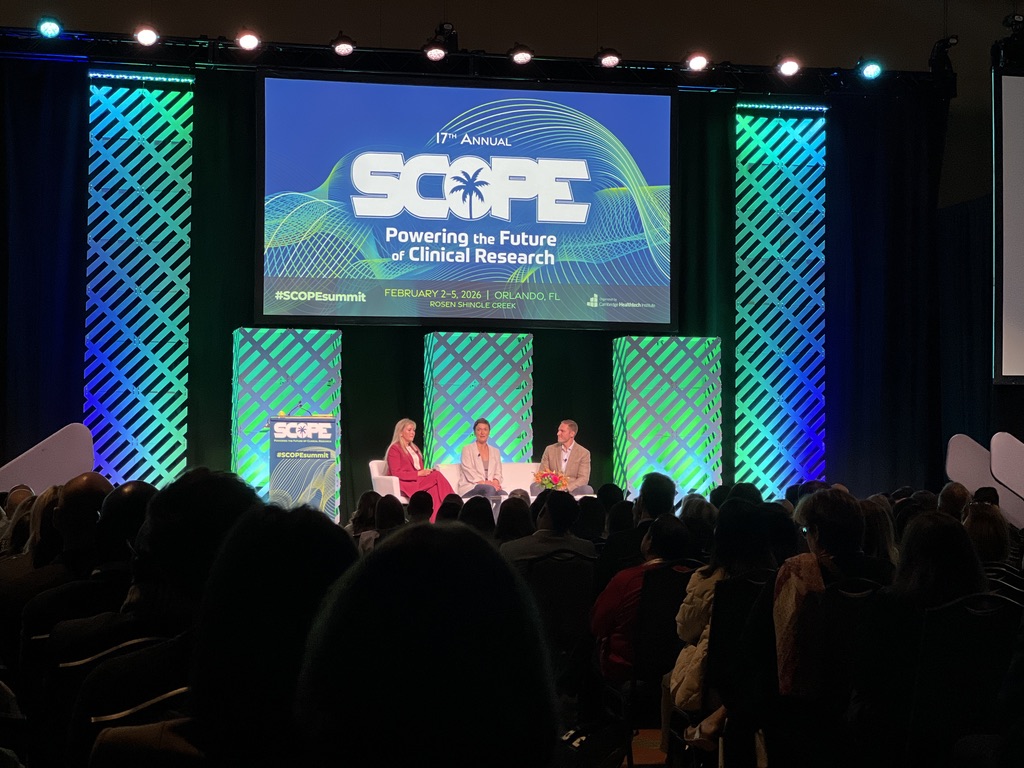
One of the most powerful moments of the conference came from the opening keynote on patient experience and hope. Hearing directly from patients and advocates reminded me that hope is not an abstract concept. It’s a reality that goes on around us, often under immense pressure of our everyday lives.
Patients enter clinical trials with hope for treatments that don’t yet exist. They give us the most important thing they have: their bodies. And they navigate an overwhelming system of document after document, stringent eligibility criteria, nebulous terminology, site logistics, delays, and uncertainty.
For some, hope means enduring complicated screening procedures. For others, it means desperately waiting for a phone call from a site while life is put on a pause. As one speaker shared, by the time patients finally enter a study, they are often inundated with information at a moment when clarity is hardest to find.
What struck me most was how frequently patients described becoming “professional patients.” They felt forced to master a complex system simply to survive it. Many spoke about the mental toll: trying to make life-or-death decisions while lacking clear guidance, continuity, or a reliable point of contact.
And yet, hope persists. For patients who benefitted from innovative therapies, the journey was worth it. But nearly all reflected on how much easier it could and should have been.
That’s a responsibility we cannot ignore.
Another recurring theme at SCOPE was a challenge to long-standing assumptions in clinical trial operations.
We heard repeatedly: “No more ‘this is how it’s always been done.’”
Quite often, protocols are built by copying prior studies rather than really understanding patient needs for each therapeutic area, challenges at each site, and what data actually matters.
A surprising point raised was how much data collected in trials is never used. Every extra assessment, visit, or procedure adds significant burden to patients and sites, and when it does not meaningfully improve outcomes, that burden can be devastating for patients.
True patient centricity isn’t a buzzword like AI. It’s designing trials that meet patients where they are: reducing unnecessary clinic visits, accommodating real-life constraints like childcare and work, and creating experiences that are feasible in the real world, not just on paper.
Simpler trials may turn out to be the most impactful ones.
The question of acceleration came up repeatedly: Are we actually speeding up drug development, or just shifting work around?
Technology has clearly improved productivity. From pen and paper to Electronic Data Capture (EDC), centralized monitoring, decentralized trials, and digital devices. However, overall timelines haven’t meaningfully changed.
And yet, there was cautious optimism. Several speakers emphasized that acceleration doesn’t start with technology. It starts with decisions made upfront. Site selection, enrollment readiness, protocol design, and data strategy all compound over time, for better or worse.
AI came up often, but not as hype. The most grounded discussions focused on how AI can help teams navigate fragmented data, reduce systematic errors, surface safety signals earlier, and support better decision-making. But only if embedded thoughtfully into existing processes and workflows.
The consensus was that technology is advancing quickly and will not be the barrier. The harder problem is human: how teams collaborate, share information, and align incentives across sponsors, CROs, and sites.
Acceleration will not come from any one team innovating in isolation. It will come from working together as an industry, grounded in trust and shared purpose to improve patient outcomes.
There was also acknowledgment of the broader context. This is a difficult moment for science, funding, and innovation. Smaller biopharmas face intense pressure to be selective, disciplined, and operationally excellent. Clinical operations leaders are navigating uncertainty, transitions, and constrained resources, all while trying to move programs forward responsibly.
And yet, it’s worth remembering what clinical trials have already achieved. They have bent the curve on mortality in oncology and transformed once-fatal diagnoses into manageable conditions. Life today is fundamentally better because of the work this industry has done.
The question we must keep asking is simple, but not easy: What is most important for the people we are trying to treat?
SCOPE 2026 reinforced for me that the future of drug development is not just about faster clinical trials or better technology. It’s about earning trust from patients, sites, caregivers, regulators, and each other.
Hope is powerful. And “with great power comes great responsibility.”
If we design trials with empathy, discipline, and transparency, we can honor the trust patients place in us, and use innovation to reduce burden rather than add to it. We can advance new treatments to those who need them faster.
And ultimately, that is the end goal of what we're all working towards.

Say goodbye to tedious spreadsheet trackers and finish trials ahead of schedule.
.png)

.png)
.png)
.png)
.png)
.png)
.png)
.png)