By
Jin Kim
June 22, 2026
•
5
min read
.png)
Most study teams already have the data they need.
The problem is that it's scattered across EDC, IRT/RTSM, central labs, eCOA, CTMS, recruitment platforms, CRO reports, and countless spreadsheets.
As a result, teams often spend hours each week pulling reports, updating trackers, and reconciling numbers just to answer a basic question:
“What is happening in my study right now?”
And that challenge is only becoming more difficult. A landmark study by the Tufts Center for the Study of Drug Development found that the number of data points collected in Phase III clinical trials increased by 283% over a ten-year period. Study teams are being asked to monitor more data, more systems, and more operational signals than ever before.
The challenge is not just collecting more data, but ensuring the right information reaches the right people quickly enough to take action.
Today, clinical trials rely on a growing ecosystem of technology platforms and service providers. Sponsors may use one system for electronic data capture (EDC), another for clinical trial management (CTMS), yet another for randomization and drug supply (IRT/RTSM), and additional vendors for eCOA, central laboratory services, recruitment, and site management.
Each system serves an important purpose, but operational issues are rarely isolated within a single system. A site experiencing slower-than-expected enrollment may also be generating more protocol deviations. Delayed data entry may affect downstream monitoring activities. Recruitment campaigns may be generating referrals but not translating into screenings and randomizations. The signals often exist, but they are distributed across multiple systems, reports, and stakeholders.
These systems often don’t naturally work together, and as a result, many study teams spend hours every week reviewing vendor reports, updating trackers, reconciling numbers, and preparing for study review meetings. A report is exported from one system, another arrives from a CRO, and a third comes from an internal team. The numbers do not quite match, often because reports were generated at different points in time or use different business logic. Additional time is then spent reviewing discrepancies and determining which version is the right one to reference. By the time everyone aligns on what is happening, opportunities for earlier intervention may already have passed.
While study data is spread across many systems, conversations about that data tend to happen in far fewer places. For many biotech sponsors and CROs, Microsoft Teams has become the central hub for communication and collaboration. Teams use it to coordinate study execution, escalate issues, discuss site performance, review operational risks, and align stakeholders across functions.
When enrollment slows, people often discuss it in Teams. When a protocol deviation requires review, people discuss it in Teams. When a study milestone is at risk, people discuss it in Teams.
Yet the operational signals driving those conversations often remain disconnected from the conversation itself. Teams frequently switch between dashboards, reports, spreadsheets, and emails simply to gather enough information to understand the situation. This disconnect creates friction and slows decision-making.
At Miracle, we believe visibility only creates value when it reaches the people who can act on it. That belief led us to build the Miracle app for Microsoft Teams.
Rather than requiring teams to constantly monitor dashboards or wait for periodic reviews, the Teams app brings important study signals directly into the collaboration platform teams already use every day. Study teams can receive real-time alerts configured in Miracle and collaborate around those issues directly within Microsoft Teams.
For example, a team may be notified when enrollment activity changes unexpectedly, a query hasn’t been addressed for a prolonged period, site activity falls behind expectations, or a new adverse event requires attention. Instead of discovering the issue during a weekly review meeting, teams can identify it earlier and begin discussing next steps immediately.
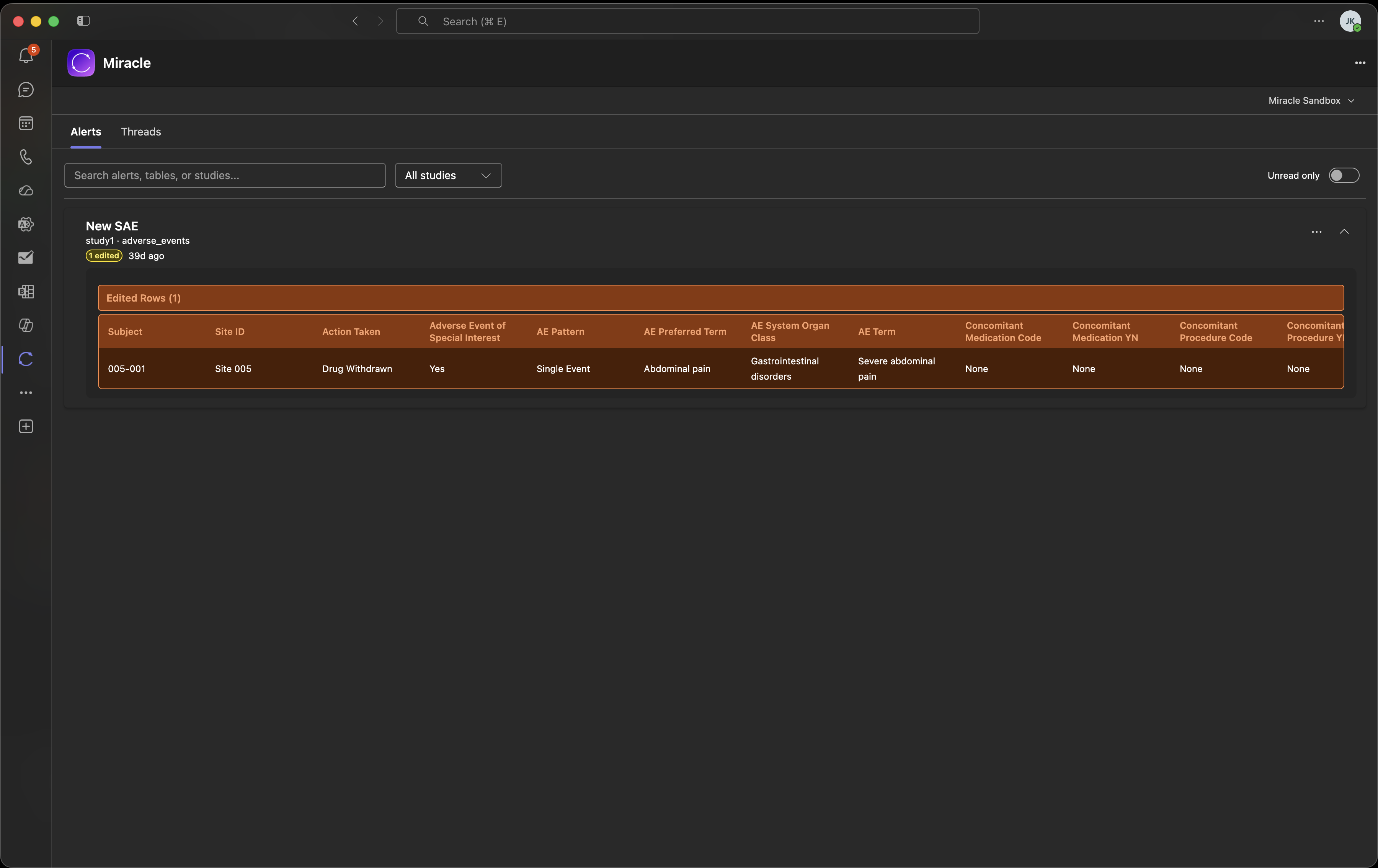
The goal is to make important information more accessible when action is needed.
Clinical trials continue to grow in complexity. Protocols include more endpoints, studies involve more vendors, and data is generated across more systems than ever before. At the same time, study teams are being asked to operate with tighter timelines, greater oversight expectations, and limited resources.
Our vision is simple: help the right information reach the right people faster.
The launch of the Miracle app for Microsoft Teams is another step toward helping sponsors and CROs reduce operational blind spots and ensure that important study signals reach the right people before small issues become larger problems.

Say goodbye to tedious spreadsheet trackers and finish trials ahead of schedule.
.png)
.png)
.png)
.png)
.png)
.png)
.png)

.png)